




When Anxiety Keeps a Child Home
July 21, 2026
The beginning of a new school year brings a mixture of excitement and nervousness for many children. A little anxiety before the first day, a difficult test, or a class presentation is normal. Anxiety can help children prepare for challenges and recognize potential problems.
But anxiety becomes concerning when it consistently interferes with a child’s ability to attend school, participate in class, maintain friendships, or complete ordinary activities. The American Academy of Child and Adolescent Psychiatry (AACAP) and the American Psychiatric Association report that approximately 25% of adolescents ages 13 to 18 experience an anxiety disorder, with nearly 6% experiencing severe anxiety.
One of the most disruptive ways childhood anxiety can appear is through school avoidance or school refusal.
What Does School Refusal Look Like?
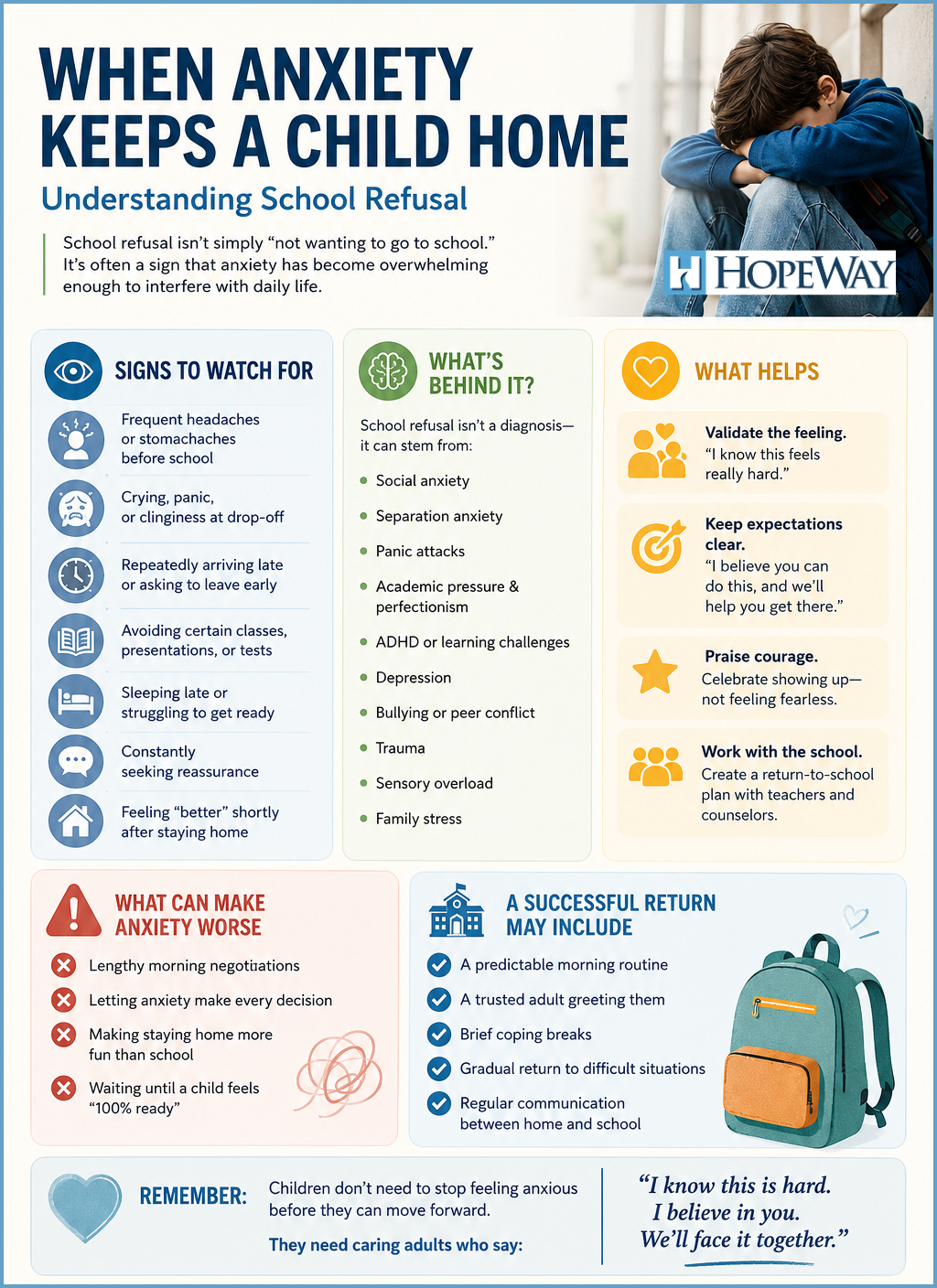
School refusal describes a pattern in which a child has significant emotional distress about attending or remaining at school. It is not always a child simply saying, “I do not want to go.” It may look like:
-
Repeated headaches, stomachaches, nausea, dizziness or fatigue on school mornings
-
Crying, clinging, panic or severe irritability before school
-
Frequently arriving late, leaving early or visiting the nurse
-
Missing particular classes, tests, presentations or social situations
-
Sleeping late or appearing unable to get ready
-
Repeated requests for reassurance from parents
-
Feeling better shortly after being permitted to stay home
These physical symptoms are often very real. An anxious child is not necessarily pretending to be sick. Anxiety activates the body’s stress response and may produce headaches, stomach discomfort, chest tightness, shortness of breath, nausea and other physical sensations. AACAP notes that these complaints may appear shortly before school, improve after the child is allowed to remain home and return the following morning.
School refusal is especially common around developmental transitions, including ages 5–7 and 11–14, when children may be adjusting to elementary or middle school. It may also emerge after summer vacation, a holiday break, an illness, a move, a change in schools or another stressful event.
Understanding What is Driving the Avoidance
School refusal is not a single diagnosis. It is a behavior that can have many possible causes. In younger children, separation anxiety may be a major factor. Older children and adolescents may be struggling with:
-
Social anxiety or fear of embarrassment
-
Panic attacks
-
Academic pressure or perfectionism
-
Learning difficulties or ADHD
-
Depression
-
Bullying or peer conflict
-
Trauma
-
Sensory overload
-
Family stress
-
Fear of vomiting, becoming ill or using school bathroom
This is why the goal should never be to force a child back into an unsafe or genuinely harmful environment without first understanding the situation. Reports of bullying, harassment, academic difficulties, discrimination or safety concerns should be investigated promptly.
At the same time, waiting until a child feels completely comfortable before returning to school can unintentionally prolong the problem. Anxiety often decreases after avoidance, creating immediate relief. The brain then learns, “Staying home kept me safe.” The next school morning may feel even more threatening.
AACAP’s parent guide specifically cautions that caregivers can unintentionally strengthen anxiety by supporting avoidance rather than engagement.
Supporting Your Child Without Enabling Anxiety
In my work with children and adolescents, I often see families become trapped in a painful cycle. A child feels anxious, the parent allows them to stay home to reduce the immediate distress, and everyone feels relieved. Unfortunately, that relief can teach the child’s brain that avoidance is the safest solution. The most effective response combines empathy with confidence and clear expectations.

Validate The Feeling Without Agreeing With The Fear
Validation means recognizing that the distress is real. It does not mean confirming that the situation is dangerous or impossible. One of the most important things I tell parents is that validating anxiety is not the same as allowing anxiety to make every decision. An example: Parent might say:
“I can see that you feel very anxious this morning. I believe you, and I know this feels hard. I also believe you can handle this, and we are going to help you get to school.”
Try to avoid repeated statements such as, “Are you sure you can do this?” or “You do not have to go if it feels too scary.” Although reassuring in the moment, these messages can communicate that the child may not be capable of coping.
Keep The Expectation of Attendance Clear
Unless a child is medically ill or there is a genuine safety concern, the general expectation should be that school attendance continues.
Lengthy debates each morning usually increase anxiety. A brief, calm routine is more effective saying something like, “I know you are uncomfortable. We have a plan, and the plan is to go to school. Your counselor will meet you when you arrive.”
Parents should aim to be warm but firm rather than angry, threatening or punitive. Anxiety is not misbehavior, but avoiding every anxiety-provoking situation is also not an effective long-term treatment.
Make Staying Home Neutral Rather than Rewarding
When a child remains home because of anxiety, the day should resemble a quiet sick day. That generally means no gaming, social media, play dates with friends, outings, special treats or unrestricted entertainment during school hours. Schoolwork and a normal waking schedule should continue when possible.
This is not intended as punishment. It simply prevents staying home from becoming more appealing than attending school.
Reduce Accommodations Gradually
Family accommodation occurs when relatives change routines or take over responsibilities to prevent a child from feeling anxious. Examples include speaking for a child who fears social interaction, repeatedly checking assignments, allowing a child to avoid all presentations or providing hours of reassurance.
Parents should not abruptly remove every support. Instead, accommodations can be reduced in planned, manageable steps while teaching the child coping skills. A helpful message is: “I will support you while you do this, but I will not do it for you.”
Praise Courage Rather Than the Absence of Anxiety
Success does not mean feeling completely calm. Success means moving forward while anxious. Instead of saying, “See, there was nothing to worry about,” try: “You were nervous, and you still walked into school. That took courage.”
This teaches children that they do not have to eliminate anxiety before participating in life.
Creating a Return-to-School Plan
The longer a child remains out of school, the more difficult returning may become. Early communication among the family, school and treatment team is essential.
AACAP recommends a structured and timely return that may include shortened days initially, check-ins with a trusted adult, or other temporary supports. Depending on the child’s needs, formal accommodations may be provided through a Section 504 plan or Individualized Education Program.
A return plan might include:
-
A consistent morning routine
-
A specific staff member who greets the child
-
A quiet location for brief coping breaks
-
Gradual exposure to especially difficult classes or situations
-
A plan for physical complaints that limits repeated dismissal
-
Predictable communication between parents and school
-
A timeline for gradually reducing temporary accommodations

The goal of an accommodation should be to help the child access school, not create an indefinite pathway around every feared situation.
How is Anxiety-Related School Refusal Treated?
Cognitive behavioral therapy, or CBT, is a first-line treatment for childhood anxiety. It helps young people recognize anxious thinking, develop coping strategies and gradually face feared situations rather than continuing to avoid them.
For moderate or severe anxiety, medication may sometimes be considered alongside psychotherapy. Medication is not a stand-alone treatment for school refusal; it is one tool that may reduce symptoms enough for a child to participate more fully in therapy and school.
A comprehensive evaluation is especially important when school refusal is persistent, when an adolescent suddenly stops attending, or when anxiety occurs alongside depression, bullying, declining grades, major sleep changes or other behavioral concerns. AACAP identifies regular refusal to attend school and anxiety that interferes with daily functioning as reasons to seek professional evaluation.
The Message Children Need to Hear
Children with anxiety need to know that their parents take their feelings seriously. They also need adults to communicate confidence in their ability to cope.
The message is not: “You should not feel anxious.”
It is: “Anxiety is uncomfortable, but it is not in charge. You do not have to face it alone, and together we will help you take the next step.”
With early intervention, collaboration and a consistent plan, most children experiencing school refusal can rebuild confidence and return to school successfully.
About the Author

Katie Chambers, MD
Adult and Child & Adolescent Psychiatrist

Understanding and Overcoming Social Anxiety
December 17, 2024
Mollie Sandler, LCSW - Primary Therapist Social Anxiety During the Holidays As we navigate through the holiday season, we may find our calendars full of social engagements, celebrations, and parties....

Understanding The Teenage Brain
October 17, 2025
You often hear that adolescence is one of the biggest times for change. Teens are going through puberty, growth spurts, navigating relationships and new responsibilities. In addition to the physical,...

Helping Your Child Adjust to a New School
August 20, 2025

Meditation for Kids: A Mindful Practice for the Whole Family
August 18, 2025
Victoria Brewer, MA, NCC, LCMHC When you picture meditation, you might imagine someone sitting cross-legged in silence for long stretches of time. But for children, especially those experiencing anxie...